
Does a pale lawn always need more fertiliser?
A pale lawn does not automatically need more fertiliser. Light, water, mowing and root-zone conditions can also affect appearance. Review the pattern and recent care, and use appropriate testing before correcting an assumed nutrient shortage. A pH reading alone is not a complete nutrient analysis.
Before reaching for another bag
The lawn has lost its colour. You fed it recently, so you wonder whether the amount was too small or the product was wrong. Another feed feels like a straightforward next step.
Pause long enough to ask what the colour change is telling you. Is the whole lawn affected? Is the pale area shaded? Did the change follow a cut, a dry spell or a period when the ground stayed wet? Those details can change the answer.
Fertiliser has a proper place in lawn care. The question is whether a shortage of nutrients explains this problem, at this time, on this site. Adding more before answering that question can leave the original cause untouched.
Why can different lawn problems look the same?
Grass depends on light, water, air around its roots and suitable nutrition. A weakness in one area can show above ground as poor growth or thinning. Appearance alone does not separate those causes.
Penn State Extension lists shade, drainage, compaction, fertility and mowing among the possible causes of lawn deterioration. That is why the location and history of the problem matter. A thin patch beside a heavily used path asks a different question from a broad change following a recent treatment.
Watering also deserves a closer look. A working sprinkler does not establish that all areas receive useful coverage. Nor does a wet surface tell you everything about the root zone. Our note on the clay under your lawn explains why soil conditions belong in that conversation.

What can a soil test tell you?
A suitable soil test helps move a nutrition decision beyond guesswork. The University of Minnesota Extension’s soil-testing guide explains how testing informs fertiliser decisions. Its seasonal recommendations are for Minnesota; the value here is the principle of testing before correcting an assumed shortage.
Closer to home, Agriculture Victoria’s guide to sampling soils for testing is written for farms, but two of its points carry over to a lawn. When you are investigating a problem, take a sample from a good area as well as the poor one so the two can be compared. And wait six weeks after fertilising or liming before sampling.
The test must match the question. A pH reading helps assess acidity or alkalinity; it is not a complete nutrient analysis. A photograph cannot provide either. Ask what was tested, what the result supports and what still needs investigation.
Testing does not replace looking at the lawn. An assessment needs the results alongside light, soil condition, irrigation and the recent care record. The useful outcome is an explanation of why a change is needed, rather than a longer shopping list.
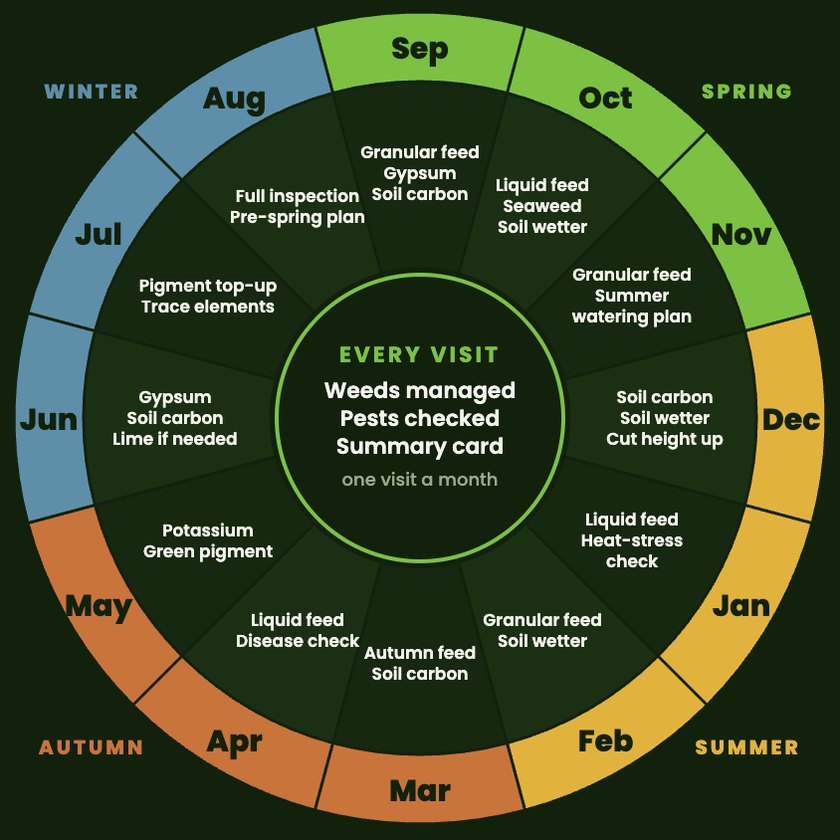
What should you record before feeding again?
Before adding another product, gather what you already know:
- When was the lawn last fed, and what was applied?
- Was the product used according to its label?
- Did the affected area change before or after that application?
- Have watering, shade, mowing or traffic changed as well?
- Has the same problem returned in the same place before?
If the details are missing, say so. An honest gap in the record is more useful than a confident guess. Keep the packaging or a photograph of its label available for the person assessing the lawn.
Avoid stacking new treatments while trying to understand the last one. Several simultaneous changes make it harder to tell what helped, what did nothing and what may have made the problem worse.
Feed for a reason
When nutrition is the limiting factor, an appropriate feeding decision can help. When the problem is inadequate light or a physical root-zone issue, extra fertiliser does not remove that constraint. The right response may involve changing care or expectations before adding anything.
For Melbourne lawns, that means reading the site through the season rather than chasing the same colour regardless of conditions. Keep a baseline photograph and a care record, then review the response to the decision you actually made.
Our broader note, Your lawn is a living system, introduces the soil beneath the grass. This note adds a narrower question: what evidence says another feed is needed now?
Local lawn care and the next step
Soil and growing conditions vary between sites. Our Bayside lawn-care page explains the local service area; an individual lawn still needs its own assessment.
See Program plans and prices, learn how the Program works, or read what the twelve visits include before deciding whether it fits your lawn.
Common questions
Does a yellow lawn always need nitrogen?
No. Poor colour can have several causes. The pattern, growing conditions and recent care need to be considered before choosing a correction.
Does this mean fertiliser is bad for lawns?
No. Appropriate nutrition is part of lawn care. The point is to apply it for an identified need, with suitable timing and label directions.
Can a pH test tell me everything the lawn needs?
No. It answers a particular soil question. Nutrient status and physical growing conditions require their own assessment.
Want to understand what your lawn needs? Learn how the Infinity Lawns Program starts with a Lawn Performance Assessment.
How the Program worksCustodianship in practice: we facilitate rather than impose, listening as much as we tend, and working with the rhythms of the living soil rather than against them.
Greenshift Infinity Lawns acknowledges the Wurundjeri Woi-wurrung and Bunurong / Boon Wurrung peoples of the Kulin Nation, the Traditional Owners and Custodians of the lands and waters of Melbourne's inner south-east on which we work. We pay our respects to Elders past and present, and recognise their continuing connection to this land, its waters, and its skies.